Dock Equipment in West Valley City, UT
West Valley City's dock equipment needs are driven by cycle count more than by any other variable, and the range across the city is wide. Food and beverage manufacturers and the larger distribution operations along I-215 and Bangerter Highway run daily trailer counts that make hydraulic levelers the only sensible specification, because spring fatigue on mechanical units accelerates sharply at that duty and shows up as repair calls within the first year or two. Smaller light manufacturing docks cycling a handful of trailers a week are a legitimate case for mechanical. Food and beverage operations add a thermal requirement on top: compression seals give the tightest envelope for refrigerated freight but wear faster and assume consistent trailer sizing, while shelters accommodate the mixed fleets most West Valley distributors actually receive. Auto parts and building materials distributors run heavier, more irregular freight, which raises capacity requirements and makes vehicle restraints more important than at a standard freight dock. Wasatch Front winter is a genuine design input rather than a footnote: a worn seal is a measurable heating cost across a season, and a drive approach that ponds will ice and change the effective trailer height at exactly the point where reliability matters most.
Dock Equipment for West Valley City Warehouses
West Valley City is Utah's second-largest city and a major industrial hub, with significant warehouse and distribution activity concentrated along the I-215 and Bangerter Highway corridors. The city's central location within the Salt Lake Valley makes it a preferred address for regional distribution operations.
Your loading dock is the highest-traffic, highest-risk area in any warehouse, and the right equipment makes the difference between an efficient, safe operation and a liability. We supply and install the full spectrum of dock equipment: hydraulic and mechanical levelers, dock seals and shelters, vehicle restraints, bumpers, dock lights, and dock boards. Our manufacturer partners include Blue Giant, Nordock, and Poweramp, and every installation is performed by trained technicians and backed by manufacturer warranty.
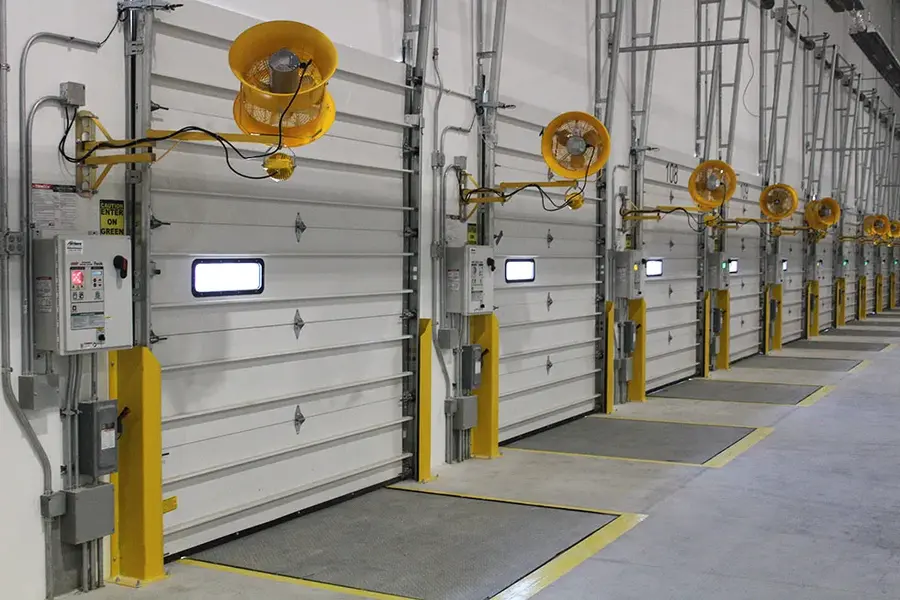
Loading dock productivity directly impacts your bottom line. A dock leveler that cycles smoothly and reliably keeps trucks moving on schedule and reduces the physical strain on dock workers. A well-sealed dock door prevents energy loss in refrigerated environments and keeps weather, dust, and pests out of your facility. Vehicle restraints keep trailers locked in place so forklifts can enter and exit safely, eliminating one of the most dangerous dock-related hazards.
Rocky Mountain Warehouse Solutions provides complete dock fit-outs for new construction projects as well as upgrade and replacement services for existing dock positions. We also offer scheduled preventive maintenance programs to extend equipment life, reduce emergency repair calls, and keep your dock compliant with OSHA and insurance requirements. Our service technicians are familiar with all major dock equipment brands, even those we did not originally install.
A loading dock is a system rather than a collection of parts, and its weakest component sets the throughput of the whole position. A high-capacity leveler behind a worn seal loses conditioned air and invites weather damage; a well-sealed door without a restraint leaves the most common dock accident unaddressed. We specify docks against the actual trailer mix, daily trailer count, and climate at your facility, because those three inputs determine whether a mechanical leveler is adequate or a hydraulic unit is the only configuration that will survive the duty cycle.
Technical Specifications & Buying Guide
Hydraulic dock levelers are the preferred choice for high-volume operations. They are activated by a push-button or pull-chain and use a hydraulic cylinder to raise the platform smoothly to trailer height before extending the lip onto the trailer bed. Hydraulic levelers require less physical effort than mechanical versions and offer smooth, controlled lowering that reduces impact on goods and equipment. Standard capacities range from 25,000 to 80,000 lbs, with pit dimensions typically 6×8, 6×10, or 7×12 feet depending on traffic volume and platform requirements.
Mechanical levelers are a cost-effective option for lower-frequency docks. They use a compressed spring mechanism activated by walking the platform up and releasing the lip. While less expensive than hydraulic levelers, they require more physical effort and are best suited for docks processing fewer than 15–20 trailers per day. Air-powered (pneumatic) levelers fall between mechanical and hydraulic in cost and performance, using an inflatable bag mechanism that provides good lip extension control without a hydraulic power unit.
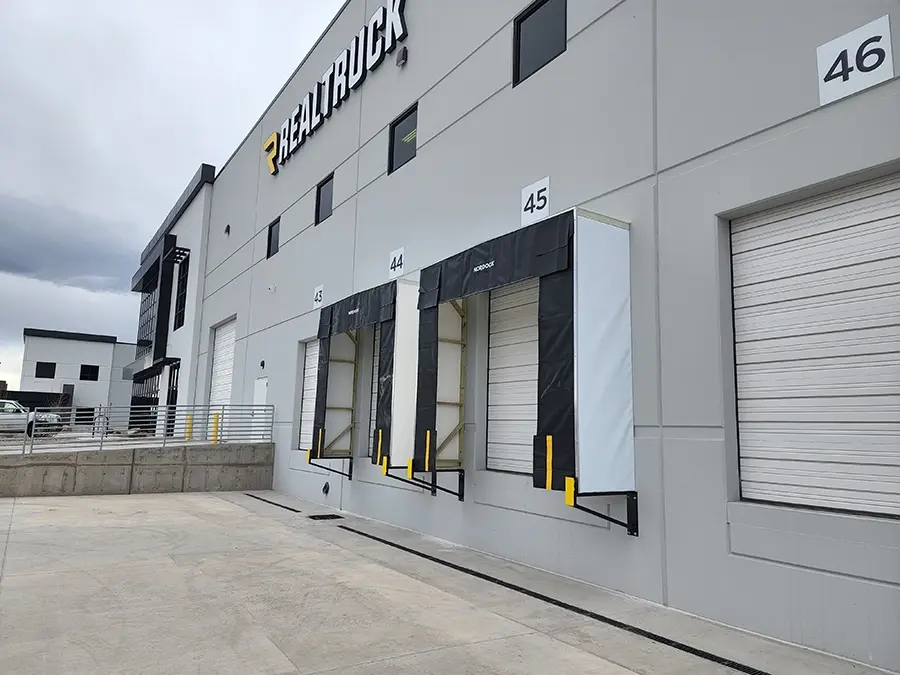
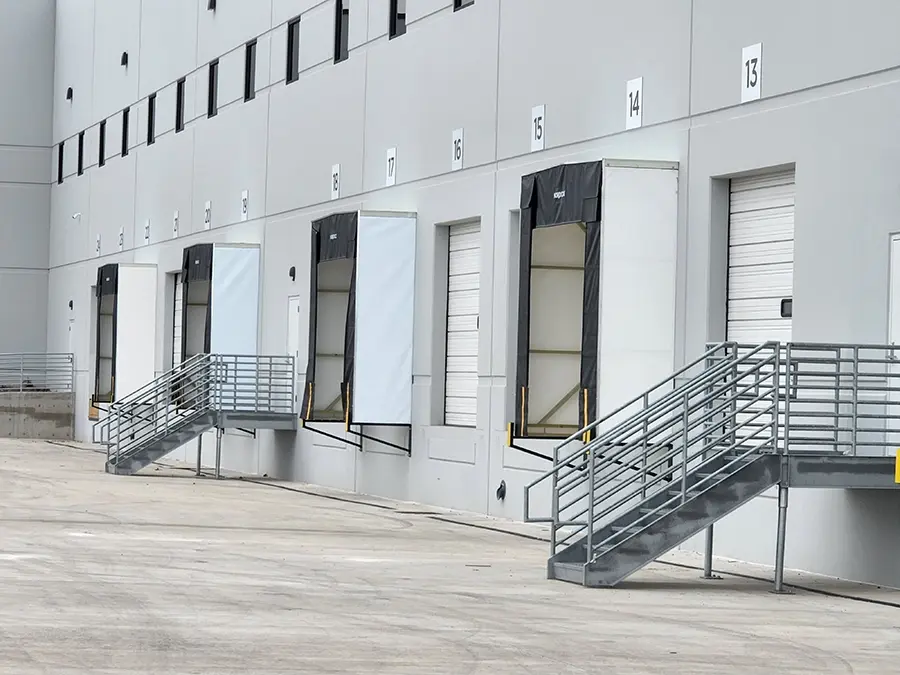
Dock seals and shelters are equally important for energy efficiency and worker comfort. Foam-pad dock seals compress against the trailer sides and top when the vehicle backs in, creating a tight thermal and weather seal ideal for refrigerated and climate-controlled facilities. Dock shelters use flexible curtains that conform to variable trailer widths and heights, accommodating a wider range of truck body sizes at the cost of a slightly less complete seal. For facilities receiving a mix of van trailers, flatbeds, and non-standard vehicles, a shelter is typically the more practical choice.
Dock leveler selection is driven by cycle frequency and load, not by door size. Mechanical levelers are spring-operated and cost the least, and they suit lower-volume docks where a handful of trailers cycle per day. Hydraulic levelers cost more but tolerate high cycle counts without the spring fatigue and manual effort that make mechanical units fail early in fulfillment environments; a dock running high daily trailer counts on mechanical levelers is usually paying for that choice in repair calls. Air-powered levelers sit between the two. Capacity is rated for the combined weight of the loaded forklift and its load crossing the plate, which is frequently underestimated because operators size for pallet weight and forget the truck. Service range matters as much as capacity: the leveler must reach both the highest and lowest trailer beds you actually receive, and a unit that cannot reach a low bed will be operated at an unsafe grade instead.
Seals and shelters solve different problems and are not interchangeable. Compression seals contact the trailer directly and give the tightest thermal envelope, which suits cold storage and food processing, but they wear faster and suit a consistent trailer size. Shelters use a fabric or rigid frame that accommodates a wider range of trailer dimensions with less contact wear, which suits mixed fleets and higher trailer variety. In cold climates a worn seal is a measurable operating cost across a heating season, not a cosmetic issue. Vehicle restraints address the highest-consequence dock hazard, trailer creep and early departure, more reliably than wheel chocks, and they integrate with dock communication lights so the driver and the dock operator share the same signal. Drive approach grade and drainage are the constraints most often ignored: an approach that ponds or ices changes the effective trailer height and puts the leveler outside its service range in exactly the conditions where reliability matters most.
Key Benefits of Dock Equipment in West Valley City
- Full-service installation and commissioning
- Hydraulic, air-powered, and mechanical leveler options
- Dock seal and shelter systems for energy efficiency
- Vehicle restraint systems for trailer safety
- LED dock lighting packages
- Preventive maintenance programs available
- Emergency repair response
Industries We Serve in West Valley City
Distribution and logistics
Dock Equipment systems tailored for the operational requirements of distribution and logistics facilities in West Valley City.
Food and beverage
Dock Equipment systems tailored for the operational requirements of food and beverage facilities in West Valley City.
E-commerce fulfillment
Dock Equipment systems tailored for the operational requirements of e-commerce fulfillment facilities in West Valley City.
Manufacturing
Dock Equipment systems tailored for the operational requirements of manufacturing facilities in West Valley City.
Third-party logistics
Dock Equipment systems tailored for the operational requirements of third-party logistics facilities in West Valley City.
Cold storage
Dock Equipment systems tailored for the operational requirements of cold storage facilities in West Valley City.
Common Use Cases in West Valley City
High-volume shipping and receiving
Facilities in West Valley City use our Dock Equipment systems for high-volume shipping and receiving because we deliver configurations that actually match how their operation works.
Temperature-controlled dock sealing
When West Valley City facilities need Dock Equipment for temperature-controlled dock sealing, we provide turnkey solutions that cover design, procurement, installation, and documentation.
Trailer restraint for safety compliance
Our West Valley City installations for trailer restraint for safety compliance are engineered to perform under real operational conditions, not just spec sheets.
Dock leveler replacement and upgrade
We configure Dock Equipment systems that solve real dock leveler replacement and upgrade challenges for West Valley City operations of every size.
New construction dock fit-out
From layout planning to final installation, we deliver Dock Equipment optimized for new construction dock fit-out in West Valley City.
Fleet maintenance facilities
Rocky Mountain Warehouse Solutions specializes in Dock Equipment for fleet maintenance facilities, serving facilities across West Valley City and the Mountain West.
Why West Valley City Businesses Choose Rocky Mountain Warehouse Solutions
Rocky Mountain Warehouse Solutions has completed over 500 projects and installed over 1,200 systems across the Mountain West, including West Valley City and the surrounding region.
As a Mountain West-based company, we serve West Valley City with the same speed and attention we give our Utah customers. Local support matters, especially when projects move fast.
Our team has completed Dock Equipment installations in West Valley City facilities ranging from 5,000 square feet to over 200,000 square feet. We size and configure every system to match your actual inventory, equipment, and growth plans.
Our process begins with a site visit to your West Valley City facility. We measure the space, review how you actually use it, and design the Dock Equipment configuration around the building you have while meeting all safety and code requirements.
Frequently Asked Questions About Dock Equipment in West Valley City
What types of dock levelers are available?
We offer hydraulic, air-powered (pneumatic), and mechanical dock levelers. Hydraulic levelers are the most popular for high-volume operations due to their smooth operation and low maintenance. Mechanical levelers are a cost-effective option for lower-traffic docks. Air-powered levelers provide a good middle ground in price and performance.
Rocky Mountain Warehouse Solutions serves West Valley City, UT and surrounding Salt Lake County businesses. Contact us for local pricing and availability.
How often should dock levelers be serviced?
We recommend annual preventive maintenance for dock levelers. High-volume docks processing 50 or more trailers per day benefit from semi-annual service. Regular maintenance prevents costly emergency repairs, extends equipment life, and ensures the leveler functions correctly every cycle.
Rocky Mountain Warehouse Solutions serves West Valley City, UT and surrounding Salt Lake County businesses. Contact us for local pricing and availability.
What is a dock seal vs a dock shelter?
A dock seal compresses against the trailer sides and top when the trailer backs in, creating a tight energy seal. A dock shelter has flexible curtains that conform to irregular trailer shapes. Seals provide better energy efficiency; shelters accommodate a wider variety of trailer sizes and are more forgiving of imprecise trailer positioning.
Rocky Mountain Warehouse Solutions serves West Valley City, UT and surrounding Salt Lake County businesses. Contact us for local pricing and availability.
Do you service dock equipment you did not install?
Yes. Our technicians service all major dock equipment brands regardless of who installed them. We carry common parts for Blue Giant, Nordock, Poweramp, and other manufacturers and can typically respond same day or next day for urgent repairs.
Rocky Mountain Warehouse Solutions serves West Valley City, UT and surrounding Salt Lake County businesses. Contact us for local pricing and availability.
What is the pit size required for a dock leveler?
Standard dock leveler pit dimensions are 6×8, 6×10, or 7×12 feet. The correct size depends on the leveler model, traffic volume, and platform capacity required. We can also install surface-mounted edge-of-dock levelers that require no pit construction, which is useful for retrofit projects where cutting a pit is not practical.
Rocky Mountain Warehouse Solutions serves West Valley City, UT and surrounding Salt Lake County businesses. Contact us for local pricing and availability.
How do I know if my dock leveler needs to be replaced vs repaired?
Signs that replacement is more economical than repair include a platform that is rusted through, a hydraulic system with multiple simultaneous failures, or a leveler that is more than 15–20 years old and requiring repeated service calls. We provide honest assessments and will recommend repair when it is the right choice.
Rocky Mountain Warehouse Solutions serves West Valley City, UT and surrounding Salt Lake County businesses. Contact us for local pricing and availability.
Should I repair or replace a dock leveler?
The practical test is age, failure frequency, and parts availability. A unit under roughly ten years old with an isolated hydraulic or mechanical failure is usually worth repairing. A unit failing repeatedly, showing structural fatigue or deck cracking, or built by a manufacturer whose parts are no longer readily available is usually worth replacing, because repair costs compound and each failure takes a dock position out of service. Calculate the cost of downtime per dock position per day and compare it against the repair history; in high-throughput operations that number frequently justifies replacement well before the hardware is fully worn out. We provide both options with cost ranges rather than defaulting to replacement.
Rocky Mountain Warehouse Solutions serves West Valley City, UT and surrounding Salt Lake County businesses. Contact us for local pricing and availability.
What are the most common dock leveler problems?
The recurring failures are a leveler that will not raise, one that drifts down under load, a lip that will not extend or return, a deck that sits below dock level at rest, hydraulic leaks, and unusual noise during operation. Most trace back to a small number of causes: spring fatigue on mechanical units, hydraulic fluid loss or cylinder seal wear on hydraulic units, debris or corrosion in the lip mechanism, or a bent deck from an overload or an impact. Many are preventable with scheduled maintenance. When you call for service, having the make, model, serial number, capacity, and photos of the failure ready shortens diagnosis considerably and often lets us arrive with the right parts on the first visit.
Rocky Mountain Warehouse Solutions serves West Valley City, UT and surrounding Salt Lake County businesses. Contact us for local pricing and availability.
How do I know what size dock leveler I need?
Size against your trailer mix and your heaviest crossing load. The leveler must service the full range of trailer bed heights you receive, from the lowest to the highest, with the grade staying within safe operating limits at both extremes. Width should suit the door opening and the equipment crossing it, and capacity must cover the loaded forklift plus its load rather than the pallet weight alone. If your trailer mix has widened over time, which is common as operations add e-commerce or LTL freight, an existing leveler may no longer reach the full range even though it was correct when installed.
Rocky Mountain Warehouse Solutions serves West Valley City, UT and surrounding Salt Lake County businesses. Contact us for local pricing and availability.
How often should dock equipment be serviced?
A documented preventive maintenance schedule of at least twice a year is the practical baseline for an active dock, with higher-cycle positions in fulfillment and food distribution warranting quarterly attention. Inspections should cover leveler operation across the full service range, hydraulic fluid and hoses, lip function, seal and shelter wear, restraint operation and interlock with dock lights, bumper condition, and drive approach drainage. Cold-climate facilities benefit from a dedicated pre-winter inspection before the first hard freeze, since the failures that strand a dock in January are usually visible in October.
Rocky Mountain Warehouse Solutions serves West Valley City, UT and surrounding Salt Lake County businesses. Contact us for local pricing and availability.
Get a Free Quote for Dock Equipment in West Valley City
Getting a quote for Dock Equipment in West Valley City is fast and free. Our team will visit your facility, assess your needs, and deliver a detailed proposal — typically within 48 hours.
Related Products in West Valley City
Request a Quote for Dock Equipment in West Valley City
Our team can help you choose the right warehouse solution, plan the layout, and move your project forward.
Get a Free Quote